Jack Welch
The Wisdom of CrowdsJack Welch appears in the book as both an advocate of less rigid corporate boundaries and a symbol of the 1990s faith in the singular, heroic chief executive. As CEO of General Electric, he pursued a more interdisciplinary and less hierarchical company, helping GE flourish; yet his own record also shows that distributing authority does not guarantee that a powerful leader will heed opposing views.
The Boundaryless Corporation
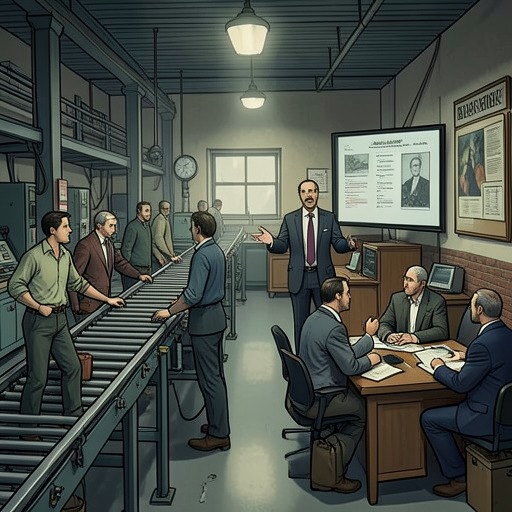
Welch’s most important initiative at General Electric was its transformation into what he called a “boundaryless corporation.” The phrase named an effort to make the company’s divisions and its relationship with outside markets less closed off. Drawing on questions about why firms exist rather than relying on markets, Welch sought to make the boundary between GE and external markets more permeable.
Within the company, he broke down barriers between divisions, arguing that interdisciplinary work could foster diversity. He also sharply reduced the layers of management between senior leaders and the rest of the organization. The changes addressed not just corporate structure but the routes by which knowledge and proposals could travel: fewer internal barriers could bring different perspectives into contact and shorten the distance between those doing work and those directing it.
Welch also tried to loosen the boundary between managers and subordinates through “Work-Out” sessions. In these meetings, managers faced often stinging public criticism from the people they managed. The practice made criticism visible rather than leaving it to travel quietly up a hierarchy, and it put pressure on the assumption that a subordinate’s role was simply to receive orders.
Decentralization and Its Limits
The account does not present Welch’s program as an unqualified success. On certain decisions, especially whether GE should spend tens of billions of dollars on acquisitions, he appeared to disregard opposing views and rely instead on his own unwavering convictions. The contrast is central to his example: a company may open channels for criticism and cross-divisional exchange without ensuring that the person at the top will accept what those channels bring.
Even so, boundarylessness was one of the features that helped GE flourish, unlike many older American industrial corporations. The book’s broader argument is that organizations can benefit when decision-making power is distributed and people close to a problem can use their local and experiential knowledge. Welch’s reforms fit that argument, but the acquisition example marks its limit: structural openness and actual deference to collective judgment are not the same thing.
The CEO as Corporate Savior
Welch also occupied a conspicuous place in the 1990s rise of the celebrity CEO. In the 1940s, the average American would not have known who General Motors chief Alfred P. Sloan was; by the 1990s, the average American knew who Welch was. The trend had begun in the 1980s, when Chrysler CEO Lee Iacocca became a symbol of resurgent American capitalism, and accelerated as executives with only a few good years were hailed as visionaries. Companies came to expect CEOs to be “corporate saviors.”
That status rested on more than publicity or the large compensation packages executives could command. Investors, the press, and the public increasingly treated the choice of the right individual at the top as the key to corporate success. The book places Welch within that larger paradox: corporations could praise decentralization and bottom-up methods while concentrating their hopes—and their judgment of success—in one celebrated leader.
Collective Judgment Beyond the Heroic CEO
The discussion ultimately argues that major corporate decisions should draw on collective judgment rather than rest with one person. The legal ideal gives boards the final say on major decisions, but in practice boards defer to CEOs, reflecting a persistent assumption that authority must ultimately reside in an individual. Welch’s career makes that assumption especially visible: his company experimented with ways to expose management to wider criticism, while some of his most consequential decisions remained governed by his own convictions.
The book’s conclusion is not that a chief executive has no role, but that expertise and authority at the top do not remove the value of informed disagreement. A small, diverse group can bring together knowledge that no single executive possesses. Welch’s boundaryless corporation therefore matters as an organizational experiment and as a caution: openness can help a company succeed, but collective decision-making depends on whether leaders allow dissent to shape the decisions that matter most.